
City Council Explores New Paths to Affordable Housing
During the January 5, 2026 City Council Housing Committee meeting, staff presented new affordable housing strategies to expand housing options while using public dollars more effectively. The discussion focused on innovative public development models that could deliver mixed-income housing without relying heavily on limited housing trust fund dollars, allowing those resources to be redirected toward deeper affordability for residents with the greatest need.
Council members emphasized the importance of serving households at the lowest income levels, creating mixed-use and mixed-income communities, and exploring pathways beyond traditional tax-credit housing, including opportunities for homeownership and neighborhood-scale development.
The conversation highlighted the need for flexible, equitable tools that align housing investment with long-term community stability and economic inclusion—priorities central to building a more sustainable Charlotte. This work is vital to keeping residents in their homes and providing more housing options in transit areas that would otherwise be too expensive for many people to afford.
New Affordable Housing Funding & Financing Tools Discussed
- Public Development Model – A city-led development approach where the City would retain control of land or assets and partners with developers, allowing projects to move forward without upfront Housing Trust Fund dollars.
- Bond-Financed Development – Use of revenue or project-based bonds to finance construction, with affordability requirements tied to the life of the financing.
- Tax Increment / Tax Rebate Mechanisms – Leveraging future tax revenues generated by a project to help offset development costs, extending affordability without deep subsidy reliance.
- Refinancing After Debt Period – Once the initial debt is paid down, projects could be refinanced to sustain affordability, fund maintenance, or reduce long-term costs.
- Reduced Reliance on LIHTC – These tools are intended to complement (not replace) Low-Income Housing Tax Credits, which are often inflexible for mixed-use and mixed-income projects.
- Trust Fund Preservation Strategy – By using alternative financing for moderate-income units, the City could reserve Housing Trust Fund dollars for households at the lowest income levels, including those below 30% Area Median Income (AMI).
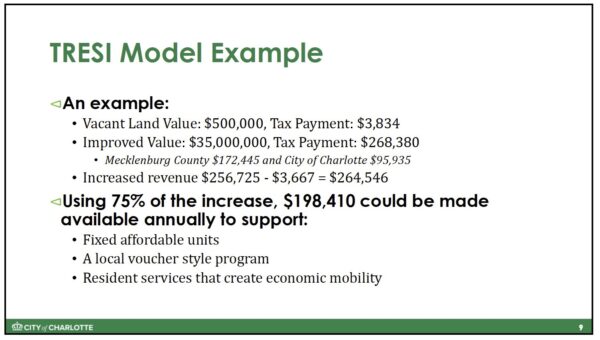
What Happens Next: City staff will continue refining new affordable housing models and return to Council with clearer options, affordability guardrails, and financial analysis. Council committee members emphasized the need to ensure deep affordability, especially for households at or below 30% AMI, while evaluating long-term fiscal impacts and alignment with equity and displacement-prevention goals. No final decisions have been made yet.
Let’s Continue Exploring These Options!
Expanding our city’s toolkit with innovative public development models is a vital step toward creating a more equitable Charlotte where every resident, regardless of income, has a place to call home. By leveraging alternative financing to support mixed-income projects, we can strategically reserve our limited Housing Trust Fund dollars to provide deep affordability for those at the lowest income levels who need it most. This shift is essential for preventing displacement and ensuring that sustainable, transit-oriented neighborhoods remain accessible to everyone, fostering a city that is truly connected and inclusive.