
When Engagement Isn’t Engagement: Shauna Bell Said What Many Are Feeling
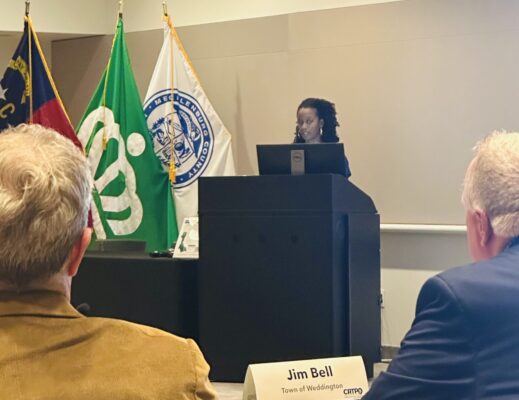
At last night’s CRTPO meeting, Shauna Bell’s voice cut through the procedural language and legal debates with clarity and urgency. View her comments here, beginning at 37:25. Bell, a resident of McCrorey Heights, delivered a powerful critique of how the I-77 South project has been handled and how the public was brought into the process. Here are highlights of what Bell said.
A 24-Day Window During the Holidays Is Not “Extensive Engagement”
Bell corrected the record on the timeline of public engagement around the project maps. The maps were released November 12 and 13, giving residents only 24 days — during the Thanksgiving holiday season — to comment. She noted that this has been described as “extensive community engagement.” Her response: “If that’s extensive engagement, then we have seriously lowered the bar to dangerously low levels.” She’s right. A compressed review window over major holidays does not meet the standard of meaningful participation for a multibillion-dollar infrastructure commitment with generational impacts.
Meaningful Engagement Happens Before Decisions Are Locked In
Bell drew an important distinction between process and participation: “Meaningful engagement is not a presentation. It is not a drop-in session. It is not a survey asking residents which two harmful designs they prefer.” She continued: “Meaningful engagement happens before contracts locking us into a 50-year commitment are signed — not after.” This is the core issue. When the public is presented with limited design alternatives after key funding or procurement steps are already underway, it can feel less like collaboration and more like damage control. Engagement must shape outcomes, not merely react to them.
“We Were Presented With a Bad Plan and a Worse Plan”
Bell described how corridor residents were asked to choose between options that both significantly increase noise, air pollution, and community division — even when one option avoided direct home displacement. “Residents along this corridor were presented with a bad plan and a worse plan that both significantly degrade our quality of life…” Selecting the less harmful option does not mean the community supports the underlying concept. It means people are trying to survive within constrained choices.
Who Has the Authority — And Why Does It Feel So Unclear?
Bell also addressed what many residents are asking: “Who has the final authority to pause this project? That feels like an intentional ruse.” When decision-making authority feels unclear (split between CRTPO, City Council, and NCDOT), it erodes trust. If residents cannot clearly see who can say “pause,” they begin to believe no one can. That perception alone is dangerous for public confidence.
The Question That Lingers
Perhaps her most pointed line was this: “Who agrees to a $4.3 billion commitment without seeing the blueprint?” That question resonated across the room. For projects of this financial and physical scale, transparency about design impacts must precede irreversible commitments. Anything less undermines public trust.
What Bell Made Clear
Shauna Bell’s remarks distilled the community’s frustration into three central truths:
- The engagement timeline was inadequate for a project of this magnitude.
- The design impacts were revealed too late in the process to meaningfully influence key decisions.
- Residents deserve genuine collaboration, not a checkbox.
At Sustain Charlotte, we believe infrastructure should connect communities rather than divide them. Public trust is built through transparency, early engagement, and genuine responsiveness. Transportation decisions that reshape neighborhoods for generations demand more than compliance with minimum comment periods. They require meaningful, early, and transparent engagement — especially when historically impacted communities are involved.
Thanks for reading!
As a nonprofit, community support is crucial for us to continue our work — including providing free articles like this. If you found this article helpful, please consider supporting Sustain Charlotte.
Want to stay in the loop? Subscribe to our free weekly newsletter and follow us on Instagram and Facebook.