
What’s Next for Safer Streets
During this year’s City Council annual strategy session, several presentations focused on transportation, safety, and economic opportunity. One of the most significant discussions came during Charlotte Department of Transportation (CDOT) Director Debbie Smith’s Vision Zero presentation about how Charlotte plans to make its streets safer.
You can watch the session here (beginning at 03:32)
Read on for a summary of the core principles of Charlotte’s commitments to safer streets — And our call for what’s needed in 2026!
Charlotte’s Strategic Mobility Plan: Built on “Safe and Equitable” Principles
Charlotte’s transportation policies are guided by the Strategic Mobility Plan (SMP), adopted by City Council in 2022. During the strategy session, Smith emphasized that the plan is intentionally built around two guiding principles.
Safe:
The transportation system should eliminate fatalities and serious injuries.
Equitable:
Mobility options should be accessible to everyone regardless of income, race, age, ability, or where they live. Everyone should be able to safely walk, ride a bike, or ride public transit to get where they need to go.
These principles shape how Charlotte prioritizes investments in sidewalks, transit infrastructure, bicycle networks, and street redesign projects.
Charlotte’s Vision Zero Commitment
Charlotte’s safety strategy is rooted in its Vision Zero commitment to eliminate traffic deaths and serious injuries.
During the strategy session, Smith explained why Charlotte adopted this approach: “Vision Zero is the commitment that no loss of life on our transportation system is acceptable.”
Charlotte formally adopted Vision Zero as part of its transportation strategy and incorporated it into the Strategic Mobility Plan, setting a long-term goal of eliminating traffic fatalities and serious injuries by 2040.
Smith emphasized that Vision Zero represents a shift in how cities approach traffic safety. Instead of focusing only on driver behavior, Vision Zero recognizes that human mistakes are inevitable and that transportation systems must be designed to reduce the likelihood and severity of crashes.
Why We Must Prioritize Safer Streets Now
Smith’s presentation highlighted the urgency of Charlotte’s safety challenge. Charlotte has seen significant increases in traffic crashes and fatalities in recent years, particularly on high-speed arterial roads.
We strongly support CDOT’s investments in infrastructure across the city including new signalized intersections and other intersection improvements, pedestrian crossing beacons, street lighting, protected bike lanes, road diets, and other changes. The first $2 Million in funding for Vision Zero has grown to $20 Million in the most recent voter-approved city bonds.
But the pace of improvements has not slowed Charlotte’s increasing rate of traffic fatalities, as shared in the recently 2025 Vision Zero Annual Report.
We must do more to prevent severe injuries and fatalities by focusing on slowing vehicles down to safe speeds and ensuring that potential conflict points between cars and people are minimized.
Many of the most severe crashes occur on a relatively small number of streets. That reality led the city to focus safety investments on specific corridors through the High Injury Network.
What Is the High Injury Network?
High Injury Networks (HINs) are a core strategy in Vision Zero programs across the country. The High Injury Network identifies the small percentage of streets where the majority of severe crashes occur.
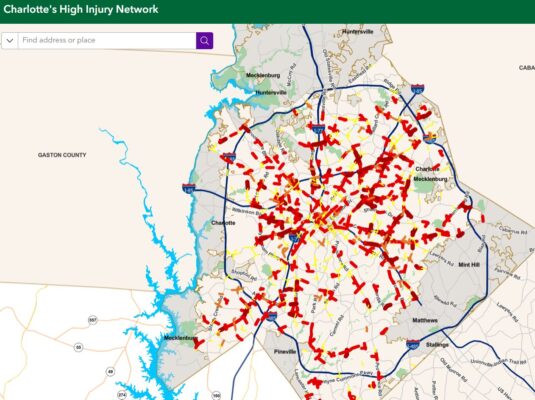
Charlotte’s High Injury Network
In Charlotte:
-
A small share of streets account for a large percentage of fatal and serious crashes
-
These corridors are typically high-speed arterial roads
-
Many also lack sidewalks, safe crossings, or protected bike infrastructure
By prioritizing improvements on these corridors, cities can significantly reduce traffic deaths and serious injuries. Charlotte uses crash data to identify these streets and target safety improvements where they will have the greatest impact.
What’s Needed to Make Streets Safer
Many cities are making progress towards their Vision Zero goals by implementing proven strategies. Here are key areas where we can make a big impact:
Redesigning dangerous corridors
Road redesigns can include lane reductions, traffic calming, improved intersections, and protected bike lanes.
Improving pedestrian infrastructure
Charlotte continues expanding sidewalks, safer crosswalks, and pedestrian signals.
Expanding bike infrastructure
Protected bike lanes and safer bike routes reduce conflicts between cyclists and vehicles.
Data-driven investments
Crash data helps the city prioritize improvements where they will have the greatest safety impact. These types of infrastructure changes have been shown to significantly reduce severe crashes by slowing speeds and improving visibility.
Safer Streets Are Also an Equity Issue
The “Equitable” principle of the Strategic Mobility Plan is also central to Charlotte’s safety strategy.
Transportation inequities often mean that residents in lower-income communities face:
-
Fewer sidewalks and safe crossings
-
Limited (or no) public transit access
-
Higher exposure to dangerous traffic conditions
Charlotte’s mobility strategy prioritizes investments in communities that have historically lacked transportation infrastructure.
Transportation Access and Economic Opportunity
Another theme throughout the strategy session was the connection between transportation and economic mobility. Reliable transportation is essential for connecting residents to jobs, education, and services.
Council members discussed how improving transit access and safe connections to transit stations can expand economic opportunity across Charlotte. The Strategic Mobility Plan also includes a long-term goal of reaching a 50-50 mode share, where half of commute trips occur via walking, biking, transit, or carpooling rather than single-occupancy vehicles.
What Sustain Charlotte Will Be Watching
The strategy session reinforced that Charlotte’s leaders recognize the importance of safer streets and better mobility options. As these discussions turn into policy decisions and budgets, we invite you to join us in watching closely to see how priorities translate into action.
Key areas include:
Investing in automated enforcement
Red light and speed cameras (where legal) are cost-effective and equitable tools to enforce traffic safety laws. Hundreds of residents joined our call this January to advocate for red light cameras, and we urge the city to begin implementing them as soon as possible.
Accelerating Vision Zero implementation
Charlotte must move faster to redesign dangerous streets and reduce traffic deaths. Our rising traffic fatality rate demands a solution to reverse this tragic trend. Every fatality and serious injury is a person, not just a statisstic.
Continuing investments in safer infrastructure
Sidewalks, protected bike lanes, safer intersections, and traffic calming save lives.
Expanding transit and transportation choices
Reliable transit and safe connections to transit stations improve access to jobs and opportunities.
Aligning transportation investments with the 2040 Comprehensive Plan
Land use and mobility planning must work together to support walkable, connected neighborhoods.