
Mecklenburg County Makes Strides Toward a Sustainable Future
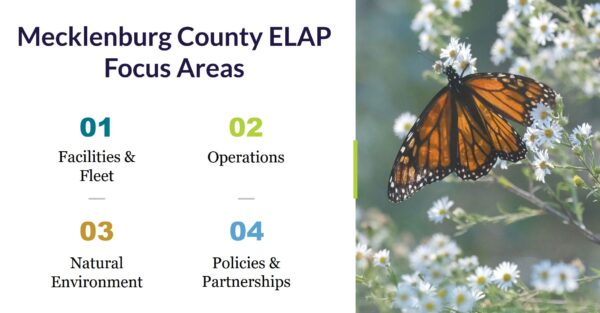
 At Sustain Charlotte, we work alongside community partners to advance local policies and practices that promote sustainable transportation and responsible land use. That’s why we’re excited to see how Mecklenburg County is implementing its Environmental Leadership Action Plan (ELAP). The County’s recent Environmental Sustainability Report shows clear progress toward reducing carbon emissions, protecting natural lands, and building a resilient future as our population grows.
Making County Operations Cleaner and Greener
Transportation is the single largest source of greenhouse gas emissions in our region. Mecklenburg County has taken bold steps to shrink its own transportation footprint by transitioning its fleet to electric vehicles (EVs). Since fiscal year (FY) 2023, the County has increased the number of EVs in its fleet from just 41 to 140 in FY25, while nearly doubling its EV charging stations from 92 to 172. This work is guided by the County’s Electric Vehicle Transition Plan and puts them on track to meet their goal of a fully net-zero carbon fleet by 2035.
As our community grows, the County’s commitment to cleaner transportation sets an example for local governments, businesses, and residents. Each EV on the road reduces harmful tailpipe emissions that worsen air quality and contribute to climate change. By expanding charging infrastructure, the County is helping to build the network needed for more residents to make the switch to electric.
County Asset & Facility Management is also improving the energy efficiency of buildings, another key source of emissions. In FY24, they surpassed their 5% energy reduction goal, and they’re now completing deep energy retrofit projects and installing rooftop solar panels. Together, these steps will further cut energy use and greenhouse gas emissions, moving the County closer to its net-zero carbon target.
Expanding and Protecting Green Spaces
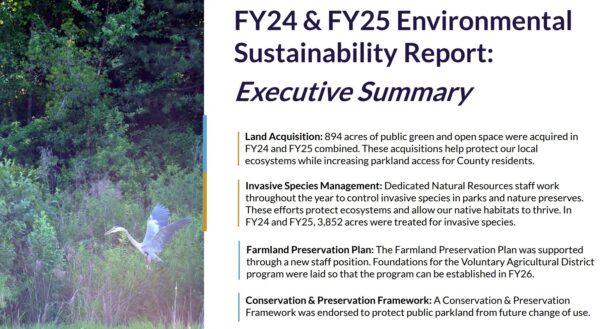
Another cornerstone of sustainability is how we use our land. Rapid growth in Mecklenburg County has put pressure on our remaining open space, but the County is making major investments to protect it. Since FY21, they’ve added nearly 2,000 acres of new parkland, greenways, and nature preserves. In FY24 and FY25, 894 acres of public green space were acquired. These areas provide crucial habitat for wildlife, protect water quality, and give residents places to walk, bike, and connect with nature close to home.
We’re also encouraged by the County’s adoption of a new Conservation & Preservation Framework in FY25. This ensures that land purchased for parks, greenways, and nature preserves will stay protected for its intended public use. As Mecklenburg County’s population grows, safeguarding land for recreation and conservation is essential to prevent sprawling development and preserve access to nature for future generations.
Building Climate Resilience Through Smarter Land Use
Climate change is bringing heavier storms and increased flooding risk. Fortunately, responsible land use can help reduce that threat. Mecklenburg County Storm Water Services had 21 active projects in FY25 addressing stream restoration, flood mitigation, and the acquisition of flood-prone properties. They also launched a Quick Buy Program after Hurricane Helene, purchasing 22 damaged homes to permanently remove them from the floodplain. Since 1998, more than 500 flood-prone structures have been removed this way, reducing future damage and opening up land for community use as parks or greenways.
This kind of forward-looking planning that steers development away from risky areas while reclaiming land for public use is exactly the type of land use strategy that makes communities safer and more sustainable.
Why This Progress Matters
Sustain Charlotte applauds Mecklenburg County for taking meaningful action through the ELAP. Electrifying the vehicle fleet, conserving and preserving green spaces, and reducing development in high-risk areas all move our community toward a future where residents can live in healthy neighborhoods connected by safe, sustainable transportation options.
These achievements show that with strong leadership and public commitment, we can make real progress toward a cleaner, more resilient Mecklenburg County. Sustain Charlotte will continue to advocate for policies that build on this momentum, including expanding sustainable transportation choices, curbing sprawl, and ensuring that all residents benefit from a thriving natural environment.
Thanks for reading!
As a nonprofit, community support is essential for us to keep doing what we do — including providing free articles like this. If you found this article helpful, please consider supporting Sustain Charlotte.
Want to stay in the loop? Subscribe to our weekly newsletter and follow us on Instagram and Facebook.