
Mecklenburg County’s Air Quality: Progress Worth Protecting
Mecklenburg County recently received an “F” grade for ozone pollution from the American Lung Association (ALA), prompting understandable concern. But the story behind the headline points to both meaningful progress and the need for continued investment in cleaner transportation and sustainable growth.
Megan Green, Mecklenburg County’s air quality program manager, shared an update with the Mecklenburg Board of County Commissioners’ Environmental Stewardship Committee on May 12th. All images in this blog post were presented at that meeting.
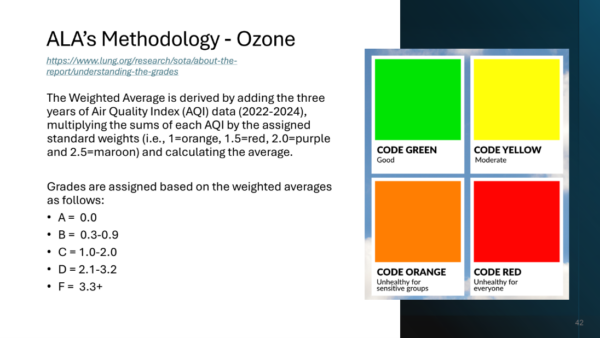
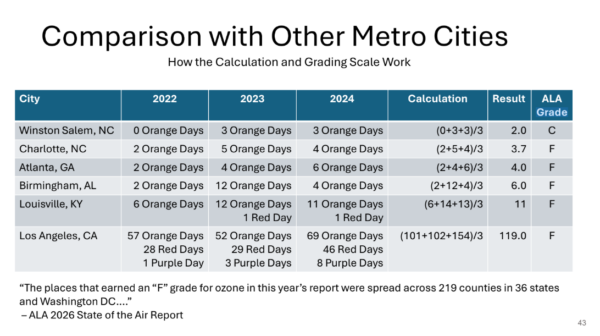
The ALA’s grading system is intentionally strict. Charlotte received a score of 3.7 based on just four “orange” air quality days in 2024. Under the ALA methodology, even a small number of elevated ozone days can result in a failing grade because the scoring system heavily weights unhealthy air quality events.
That means Charlotte and Los Angeles both received failing grades, despite Los Angeles experiencing far more unhealthy air days — including dozens of red and purple days (Mecklenburg had no red or purple days).
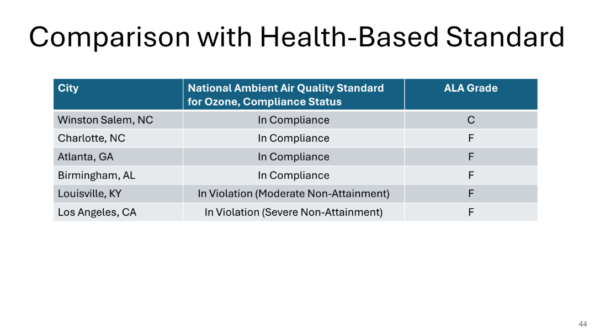
Mecklenburg County remains in compliance with federal ozone standards established by the Environmental Protection Agency. Those standards are health-based and designed to measure long-term exposure risks.
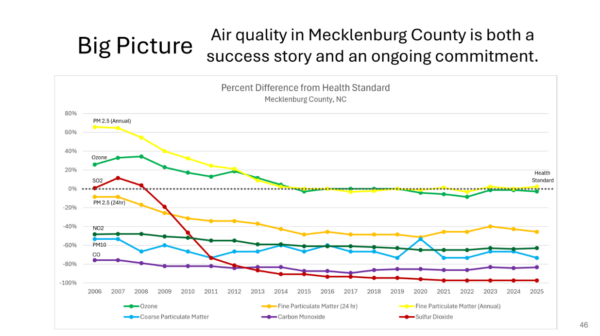
Our region has made substantial progress on air quality, and we still have important work ahead.
In fact, local air quality has improved significantly over the past two decades. According to county officials, most air quality measures today are far better than they were 20 years ago — a success story driven by cleaner technology, smarter policy, and stronger environmental stewardship. Even more encouraging, Mecklenburg County has recorded zero unhealthy air quality days so far in 2026.
That progress didn’t happen by accident. Investments in cleaner transportation, renewable energy, and green infrastructure are making a difference. Mecklenburg County and local governments are already advancing solutions such as electric vehicle infrastructure, public transit investments, solar energy, porous pavement, and expanded parks and green space.
Together with our partner organizations in the Charlotte Mecklenburg Climate Leaders, Sustain Charlotte strongly supports the Strategic Energy Action Plan, the City of Charlotte’s commitment to becoming a net-zero carbon city by 2050. Many of the same investments and policies that reduce greenhouse gas emissions also improve air quality.
Sustain Charlotte supports these efforts because transportation remains one of the largest contributors to air pollution and climate emissions in our region. Expanding transit options, making it safer to walk and bike, and supporting compact, connected development are essential to protecting public health and ensuring cleaner air for future generations.
As our region continues to grow, we have a choice: continue investing in sustainable infrastructure that improves air quality, or risk backsliding into more congestion, more pollution, and worse health outcomes.
Charlotte’s air quality story is a reminder that progress requires persistence. Smart investments in sustainable transportation and clean energy are paying off!