
New Report Shows Charlotte Still Has Work to Do to Make Walking Safe
A new national report from Smart Growth America, Dangerous by Design 2026, offers a sobering reminder that pedestrian safety remains a major challenge across the United States and here in the Charlotte region.
The Charlotte-Concord-Gastonia metro area ranks 50th among the nation’s 101 largest metro areas for pedestrian fatality rates.
Between 2020 and 2024, 287 people were killed while walking in the Charlotte metro area, up from 241 pedestrian deaths during the 2015-2019 period. The region’s average annual pedestrian fatality rate increased to 2.07 deaths per 100,000 residents.
The report examines pedestrian fatality data from 2020 through 2024 and finds that 7,080 people were killed while walking on U.S. roads in 2024 alone. While that number represents a slight decline from the record highs of recent years, pedestrian deaths remain dramatically higher than they were just 15 years ago. In fact, pedestrian fatalities nationwide have increased by 72% since 2009.
These numbers represent real people. These are parents, children, grandparents, neighbors, and friends whose lives were cut short while simply trying to cross a street, walk to a bus stop, or reach a destination without a car.
[READ OUR PRESS RELEASE: New Report Calls for Urgent Action to Reduce Pedestrian Deaths in Charlotte Region]
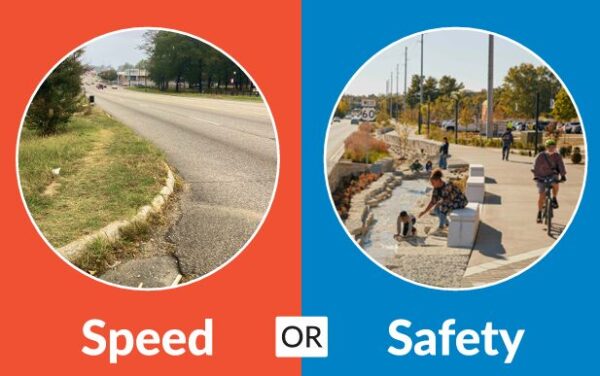
The report’s central message is one that resonates strongly in Charlotte: our roads are often “dangerous by design.” For decades, transportation planning in our area and across the United States prioritized moving vehicles quickly above all else. The result has been wide roads, long crossing distances, limited pedestrian infrastructure, and street designs that encourage high vehicle speeds even in places where people live, work, shop, and walk.
(image: Dangerous By Design 2026)
The report also highlights important equity concerns that must remain at the center of our work.
Nationally, older adults account for 23% of pedestrian fatalities despite making up only 18% of the population. Adults between the ages of 50 and 64 experience the highest pedestrian fatality rate of any age group. The report also notes that communities of color and lower-income neighborhoods continue to experience disproportionately high rates of pedestrian deaths, reflecting decades of transportation decisions that concentrated dangerous roads in historically underserved communities.
These findings mirror challenges we see in Charlotte. Residents in many lower-income neighborhoods and communities of color often face greater exposure to high-speed arterial roads, fewer safe crossing opportunities, and less complete pedestrian infrastructure. Safety improvements must be delivered equitably so that every resident regardless of age, race, income, or neighborhood can travel safely.
Charlotte is investing in safer streets. But we must act with more urgency.
Over the past several years, the City of Charlotte and other municipalities in our metro area have made important investments in safer street design, sidewalks, crosswalks, greenways, protected bike facilities, traffic calming measures, and other infrastructure that helps reduce crashes and save lives. These investments matter, and they are making a difference.
But the findings in Dangerous by Design make clear that we must move faster.
The reality is that decades of auto-oriented street design created a significant safety deficit that cannot be solved with incremental improvements alone. If Charlotte is serious about eliminating traffic deaths and serious injuries, we must accelerate investments in infrastructure that prioritizes people over vehicle speed.
Saving lives is exactly the goal of Charlotte’s Vision Zero program.
Vision Zero recognizes that traffic deaths are preventable and that transportation systems should be designed to account for human error without resulting in tragedy. The program provides a roadmap for identifying high-injury corridors, implementing proven safety countermeasures, and building a transportation network that protects everyone who uses it.
That’s why Sustain Charlotte supports policies and investments that improve safety systemwide, including the red-light camera program currently under consideration. Red-light running is a major contributor to severe crashes, and automated enforcement has been shown to reduce dangerous driving behaviors. While no single strategy will solve the pedestrian safety crisis, red-light cameras can be an important tool in a broader Vision Zero approach that combines safer street design, education, enforcement, and accountability.
We need to use all of the available tools to save lives and prevent serious life-altering injuries. That means exploring and implementing policy, enforcement, and education to address unsafe behaviors like speeding, distracted driving, and traffic signal violations. It also means making physical changes to our streets to make them safer: adding bike lanes, sidewalks, crosswalks, mid-block crossings and improving visibility at key areas like intersections.
Every person deserves to arrive home safely.
The new Dangerous by Design report should serve as both a warning and a call to action. Charlotte has made meaningful progress, but we cannot allow recent investments to create a false sense of accomplishment. The scale of the challenge demands a greater sense of urgency.
By accelerating investments in safer street design, advancing Vision Zero, implementing proven safety measures like red-light cameras, and prioritizing equity in transportation decision-making, Charlotte can build a future where walking is safe, convenient, and accessible for everyone.
The choice before us is clear: continue accepting preventable tragedies as the cost of mobility, or build a transportation system that truly values every human life. We know which path Charlotte should take.