
New Mecklenburg Public Transit Authority launches
The new Metropolitan Public Transportation Authority (MPTA) held its very first organizational meeting on Thursday evening to formally begin the transition toward a new, regionally governed transit system for Mecklenburg County.
This meeting marked the Authority’s first official gathering following voter approval of the transit referendum. It signaled the start of a multi-year effort to reorganize how transit is governed, funded, and delivered in the region.
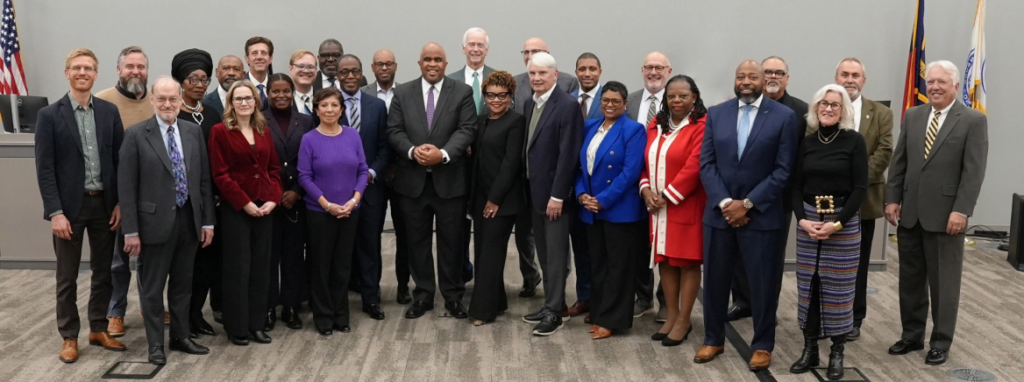 The members of the Metropolitan Public Transportation Authority at their first meeting last Thursday.
Establishing the Foundation
The first action of the new Authority was to nominate and vote in officers:
- David Howard, Chair
- Frank Emory, Vice Chair
- Christy Long, Secretary
- Ned Curran, Treasurer
During the meeting, Authority members reviewed the legal framework established by the PAVE Act and discussed the scope of work required to make the MPTA fully operational. This includes adopting bylaws, ethics and conflict-of-interest policies, and financial controls, as well as hiring or designating key staff such as a finance officer.
Members emphasized the importance of transparency, accountability, and compliance with state and federal requirements as foundational principles guiding the Authority’s work.
Transitioning Transit Operations and Assets
A central topic of discussion was the transition of transit operations from the City of Charlotte to the MPTA. This process will involve detailed planning for the transfer and use of CATS vehicles, facilities, contracts, and employees, along with coordination with state and federal transportation agencies to ensure continuity of service.
Authority members acknowledged that this transition is complex and will require careful negotiation and collaboration with the City to avoid disruptions and protect existing investments.
What Happens Next
Throughout 2026, the MPTA will adopt required studies, finalize agreements, and complete the planning work needed before the new transit tax takes effect. The tax is expected to begin as early as October 1, 2026, or January 1, 2027, at which point the Authority will begin receiving revenue and formally assume responsibility for regional transit operations.
No immediate service changes were approved at this meeting. Instead, the focus remains on building a strong foundation to support future transit investments.
How the MPTA Becomes Operational
2025: Authorization & Voter Approval
July 1, 2025
State law takes effect
A new state law (the PAVE Act) gave Mecklenburg County the ability to create a regional transit authority.
September 2025
The Authority is formed
County leaders began creating the Metropolitan Public Transportation Authority (MPTA), pending voter approval.
November 4, 2025
Voters approved transit funding
Residents vote “yes,” allowing the new authority to move forward and collect a transit tax in the future.
2026: Planning & Preparation
Early 2026
Transit plans are finalized
The Authority adopts required transit studies and shares them with state and local governments.
Throughout 2026
The Authority gets ready to operate
- Sets up rules, ethics policies, and financial safeguards
- Builds staffing, HR, and technology systems
- Plans how buses, trains, facilities, and contracts will transfer from the City
- Coordinates with state and federal transportation agencies
- Studies how to deliver major projects efficiently
Mid–Late 2026
County prepares the new transit tax
State law requires advance notice before the tax can start.
Late 2026–Early 2027: Launch
As early as October 1, 2026
(or January 1, 2027)
The new transit system officially launches
- The transit tax begins
- The MPTA starts receiving funding
- Transit operations shift from the City to the Authority
- Buses, trains, and facilities begin transferring
- Transit employees move to the new Authority
- The previous transit governance structure ends
What This Means for the Community
✔ One regional transit authority
✔ Dedicated, voter-approved funding
✔ Clear accountability and oversight
✔ A stronger foundation for transit expansion
Thanks for reading!
As a nonprofit, community support is essential for us to keep doing what we do — including providing free articles like this. If you found this article helpful, please consider supporting Sustain Charlotte.
Want to stay in the loop? Subscribe to our weekly newsletter and follow us on Instagram and Facebook.