
Parking Reform, Transit Transition, and Gateway Station’s Future
At the November 2 meeting of Charlotte City Council’s Transportation, Planning and Development (TPD) Committee, members discussed three important issues: updates to the city’s development regulations, preparations for the transition to a new regional transit authority, and the future of Charlotte Gateway Station.
These decisions will help shape how Charlotte grows, how residents access public transit, and whether our transportation investments support a more connected, affordable, and sustainable community.
Changes to Charlotte’s Development Rules Will Reduce Parking Requirements
City planning staff presented proposed amendments to Charlotte’s Unified Development Ordinance (UDO), the rules that govern how land can be developed throughout the city. These changes will largely be enacted to bring Charlotte’s regulations into compliance with recently enacted North Carolina legislation.
One of the most significant changes involves eliminating certain minimum parking requirements for new development. This change will align Charlotte’s UDO with House Bill 162, which eliminated mandatory off-street parking minimums for most new residential and commercial developments statewide. Sustain Charlotte, along with our partners in the Piedmont Promise coalition, advocated for this legislation.
Removing parking requirements gives developers more flexibility to provide parking based on actual demand rather than mandatory minimums. This allows more space for walking, bicycling, housing, businesses, and other active uses rather than just storing cars. Importantly, Charlotte’s existing maximum parking limits and standards governing parking space design would remain in place.
Other proposed UDO changes address building design standards, development review procedures, and accessory dwelling units (ADUs), which can provide additional housing options within existing neighborhoods.
A public hearing on the proposed amendments is scheduled for November 16.
Charlotte Prepares for the Next Phase of Regional Transit Governance
The committee also received an update on preparations for the Metropolitan Public Transportation Authority (MPTA) to assume responsibility for operating the Charlotte Area Transit System (CATS) on January 1, 2027. This transition is a major milestone in the region’s efforts to expand and improve public transportation following voter approval of the transportation sales tax in November 2025.
City staff outlined several agreements being developed to ensure that transit operations continue smoothly as responsibilities shift from the City of Charlotte to the MPTA, including:
- Transit facilities and infrastructure: The MPTA will need continued access to certain city-owned assets, including properties that cannot immediately be transferred because of existing financial obligations.
- Shared services: The city will temporarily continue providing certain services, such as bus stop sign production, while the new authority establishes its own capabilities.
- A shared vision for Uptown mobility: Charlotte and the MPTA will coordinate planning for transportation facilities and development opportunities in Uptown.
The proposed agreements are scheduled for City Council discussion on November 23 and consideration for approval on December 14.
The real measure of success will be what residents experience: more frequent and reliable bus service, safer and more accessible stops, better connections throughout Mecklenburg County, and progress on planned rail investments.
What’s Next for Charlotte Gateway Station?
The committee’s final major discussion focused on Charlotte Gateway Station, a long-planned multimodal transportation hub in Uptown. Gateway Station is envisioned as a major connection point for passenger rail and other transportation services, alongside surrounding mixed-use development.
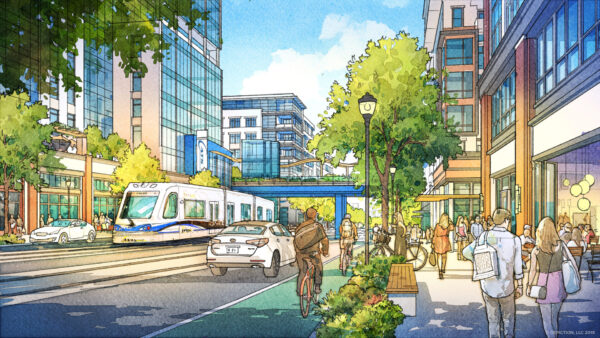
(Architectural Illustration of the future Gateway Station by Skibba Zanetta; from City of Charlotte)
However, the private development component of the project has faced significant challenges. City staff explained that changing market conditions have made it difficult to establish a reliable timeline for development. The city has extended its exclusive negotiating arrangement with Charlotte Gateway Partners through the end of 2026, providing additional time to determine the project’s next steps.
Committee members emphasized the importance of maintaining City Council involvement in decisions about the site and coordinating plans with the MPTA and other regional partners. A successful Gateway Station should prioritize convenient connections between transportation modes, safe pedestrian and bicycle access, as well as development that is accessible without a car.
Watch the meeting: Charlotte City Council Transportation, Planning and Development Committee — November 2, 2026