
Public Comment Demanded a Pause on I-77 South. We Won a Key Transparency Step!
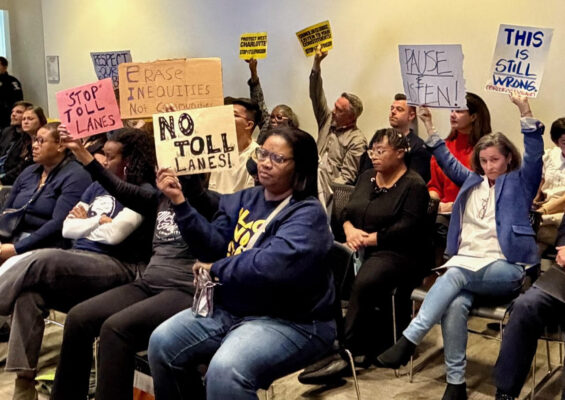
Last night’s CRTPO Board Meeting (Feb. 18, 2026) opened with a moment of accountability and then moved into a powerful public comment period where residents, advocates, and community leaders made it clear: the current I-77 South approach is putting neighborhoods at risk, and the process has not earned public trust. View the meeting here. Public comments are at the beginning, with an additional speakera, Shauna Bell, at timestamp 37:25. Board Member comments begin at 47;22.
Before public comment even began, CRTPO Board Member Leigh Altman requested that the Board direct CRTPO’s attorney to provide a legal opinion (with citations) on a central question: Whether the previous CRTPO resolution approving the I-77 South P3 is “an irrevocable legal bar” to rescinding that approval. The Chair did not add it to the agenda as a formal action item, but the Board agreed by consensus to direct staff to engage the attorney and produce that written opinion.
For everyone who showed up asking “Who actually has the authority to pause this project?” — this is an essential first step. It’s a concrete move toward clarity and accountability.
What the public told CRTPO: I-77S toll lanes threaten displacement and repeat old harms in a new form
Sean Langley, Rickey Hall, Reverend Doctor Janet Garner-Mullins, Shauna Bell, Carson Cone, and several other residents spoke courageously and compellingly during the meeting’s public comment period. Speaker after speaker described the I-77 corridor (especially West Boulevard / Wilkinson) as a place where transportation decisions have historically divided communities, displaced families, and weakened generational wealth.
Last night, residents warned that their neighborhoods are already facing intense displacement pressure. Adding I-77S toll lanes would further intensify and accelerate that pressure. Speakers cited investor activity, rising land values, tax foreclosure risk, redevelopment, and rent increases as the mechanism of “quiet displacement.” These are happening today, and would get worse if the I-77S expansion moves forward.
Many speakers urged CRTPO to reject “more lanes” thinking and focus on transit, safety, and smarter operations
Multiple speakers challenged the core premise that adding lanes will solve congestion, citing induced demand and the long-term financial and equity risks. People emphasized they are not “anti-infrastructure”. They are demanding that investment protect existing residents and not sacrifice community stability for mobility.
Ideas raised publicly included:
- Prioritizing rail and high-capacity transit
- Improving safety and functionality via interchange/exit reconfiguration
- Better traffic operations (metering, routing strategies, freight diversion to bypass routes)
- Phasing projects and exploring municipal bonds rather than committing to a decades-long public-private partnership structure
One late-added speaker at yesterday’s CRTPO Board meeting, McCrorey Heights resident Shauna Bell, described a compressed engagement window around the release of project maps, arguing the process felt like being presented with “a bad plan and a worse plan,” rather than real co-creation. She directly questioned how major commitments could advance before the public saw the full impacts. Read what Bell shared here. The throughline: Charlotte can meet growth without doubling down on needless and outdated highway expansion that deepens inequity by locking the region into high-cost, low-return outcomes.
Process and transparency were major themes — especially the timing of maps and public engagement
A recurring frustration was that communities feel they were asked to react to a decision already moving forward, rather than participate meaningfully before key commitments were made. This concern mirrors broader public skepticism about whether decision points have been clearly communicated. Residents feel they were just offered a comment box, not opportunities for genuine influence.
Board Members echoed the public’s concerns. Several questioned the very idea of elevated highways
When the Board reached member comments (starting around 47:22), the tone shifted from routine governance to frank reflection.
Mayor Higdon: U.S. cities are removing elevated highways, not building them
Town of Matthews John Higdon described looking for examples of major U.S. cities building elevated highways today and said he found none. Instead, he named multiple cities that have torn down elevated highways and others considering doing so. Nationally, there is a well-documented movement toward freeway removal and reconnection efforts, including removals and major removal proposals in places like San Francisco, Milwaukee, and Rochester, and major replacement plans such as Syracuse’s I-81 viaduct removal / community grid project. Mayor Higdon also said the only places building elevated highways today are “third-world countries.”
Leigh Altman: “bait and switch” and the maps
Altman delivered some of the meeting’s most forceful remarks, stating that the Board’s discussions focused on the P3/funding model and that the maps came after key decisions. She said she would have had a different orientation had the impacts been clear earlier, and described the situation as feeling like a “bait and switch.” This matters because trust is infrastructure. When communities believe decisions are made first and revealed later, it becomes nearly impossible to build durable public support.
Last night showed the region is demanding better than “business as usual”
Public comment made something unmistakable: Charlotte residents want congestion and safety addressed. But this can’t come at the cost of displacement, division, and decades of lock-in to an interstate expansion the community didn’t meaningfully shape. The Board’s action to request a formal attorney opinion is a real step forward: we need clarity on authority, timelines, and options. We’ll be watching for that legal opinion, and we’ll keep pushing for a path that:
- Protects neighborhoods from displacement pressures,
- Prioritizes transit and multimodal solutions,
- Centers safety and public health,including air quality and reduced greenhouse gas emissions
- Rebuilds trust through transparent, accountable decision-making.
Thanks for reading!
As a nonprofit, community support is crucial for us to continue our work — including providing free articles like this. If you found this article helpful, please consider supporting Sustain Charlotte.
Want to stay in the loop? Subscribe to our free weekly newsletter and follow us on Instagram and Facebook.