
Sustain Charlotte Comments at Press Conference on SB 266
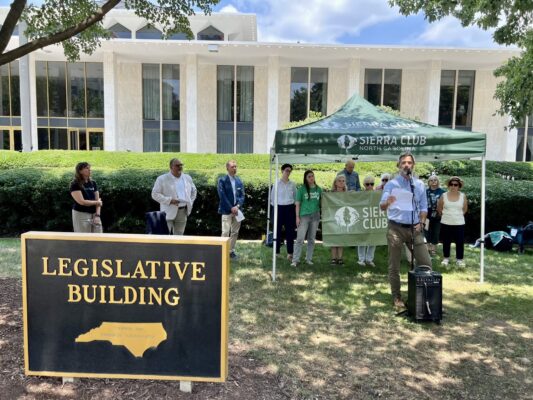
On Thursday, June 26, Sustain Charlotte Founder and Executive Director Shannon Binns joined residential ratepayers and representatives of other organizations at the N.C. General Assembly to outline the damaging economic and environmental impacts of Senate Bill 266, misleadingly named the Power Bill Reduction Act, and ask Gov. Josh Stein to veto the measure.
Below are the remarks Shannon delivered.
Our region is already facing a 14.6 percent rate hike over the next three years, with the first 8 percent chunk already baked into bills this winter.
By 2026 the typical 1,000-kilowatt-hour household will pay almost $20 more every month—money that could buy groceries, prescriptions, or school supplies instead of paying off a utility’s balance sheet.
S 266 tells those same families, “Get ready to pay even sooner.” The bill lets Duke Energy charge us for construction work in progress (CWIP) before a single watt of electricity is delivered—“pay-first, power-later” financing that puts all the risk on customers while guaranteeing profits for shareholders.
Let’s look at what “pay-first, hope-for-power-later” has meant in other states:
• South Carolina – V.C. Summer Nuclear Expansion
Ratepayers are still shelling out about $8 every month for a project that was abandoned in 2017 after $9 billion had already been spent. They will keep paying for years—without a single kilowatt to show for it.
• Georgia – Plant Vogtle Units 3 & 4
After more than a decade of delays and ballooning costs that have topped $35 billion, Georgia Power customers face a cumulative 10 percent bill increase—roughly $14 extra per month for the average home—just to cover the utility’s capital costs.
• Mississippi – Kemper “Clean Coal” Plant
State regulators approved a rate hike of up to $16 per month—a 12–13 percent jump—for customers to finance Kemper while it was still under construction. The plant never delivered on its promises and much of its original design was abandoned.
• Florida – Crystal River-3 Nuclear Repair
Duke Energy Florida customers continue to see separate line items—an “asset-securitization” fee of $2.87 today and earlier surcharges that pushed bills up $5–6 a month—to pay for a reactor that cracked during repairs and was permanently shut down.
The pattern is painfully clear: CWIP shifts multi-billion-dollar gambles from Wall Street to Main Street. When projects go over budget—or never produce power—families and small businesses keep writing checks long after the ribbon-cutting parties have been cancelled.
Governor Stein, Charlotte-area residents—and North Carolinians across the state—are already paying more for electricity, breathing dirtier air, and shouldering the risk of extreme weather outages. S 266 would hit them with financing charges upfront, slow our progress toward cleaner energy, and break the promise our state made in 2021.
I respectfully urge you to veto S 266.
Let’s protect household budgets, keep our clean-energy commitments, and ensure that North Carolina never becomes the next cautionary tale in the long, expensive history of CWIP boondoggles.
Thank you.
Thanks for reading!
As a nonprofit, community support is essential for us to keep doing what we do — including providing free articles like this. If you found this article helpful, please consider supporting Sustain Charlotte.
Want to stay in the loop? Subscribe to our weekly newsletter and follow us on Instagram and Facebook.