
We stood with residents for a W. Craighead station on Red Line
On August 12th, the Metropolitan Public Transit Authority held an important vote on the planned Red Line commuter train between Charlotte and Davidson. The vote (watch here) brought both disappointing news and an important win: trustees did not add a West Craighead Road station to the future Red Line, but they unanimously directed CATS to undertake a more detailed study of the station’s viability. That study keeps Craighead alive at a moment when it could otherwise have been pushed off indefinitely.
We are glad MPTA approved a station at Camp North End, which will improve access to one of Charlotte’s fastest-growing destinations. But leaving Craighead out of the current alignment remains deeply concerning, especially for north Charlotte communities that would see trains pass through without a nearby station.
The Craighead study is a real victory
The unanimous vote to study Craighead matters because it creates a path for the station to still be included while Red Line planning continues.
We especially thank MPTA Trustee Bob Menzel, who strongly advocated for Craighead and proposed the study after it became clear there were not enough votes to add the station immediately.
“This is just trying to get us started now and not waiting 8 to 10 years down the road,” said Menzel, who made the motion for the study.
Important details still need answers: Who will conduct the study? What is the timeline? What criteria will be used? And if the study recommends a station, what process will ensure that recommendation can actually change the project?
Because CATS previously recommended against Craighead, the new study should be transparent and credible, with a clear methodology and meaningful involvement from the City of Charlotte, Mecklenburg County, property owners, and community stakeholders.
Trustee T. Anthony Lindsey captured one of the concerns with the earlier process:
“It seems there was a decision made to exclude Craighead and then all the facts were found to support that decision.”
Plan for the region we want to become
Mecklenburg County Manager and MPTA Trustee Mike Bryant put it well:
“When we took this oath, and we agreed to serve on this board it was from a transformative perspective,” said Mike Bryant, Mecklenburg County manager and MPTA trustee. “It was based on what Charlotte could be tomorrow, not necessarily what it is today.”
Charlotte has already seen how rail transit can shape neighborhoods. South End did not become a thriving, walkable mixed-use district before the Blue Line arrived. Residents in north Charlotte deserve that same opportunity.
Sustain Charlotte and area residents spoke up
In partnership with north Charlotte residents who are asking for this stop, Sustain Charlotte has worked for the past two years to support their calls for it to be included in the Red Line.
North Charlotte resident Karen Sullivan highlighted that the 42 trains passing through the community every day will bring disruption, but could also bring great benefits if a W. Craighead stop is added: job creation, economic development, workforce stabilization, increased mobility, and environmental justice. These are all factors the FTA considers when evaluating transit plans for potential federal funding.
Ballantyne resident Janice Robinson also highlighted the equity stakes:
“This rings of discrimination and the furthering of a caste-like system in our county,” she said. “Why would we put a tax on the backs of marginalized people in this county and then present such an unfair proposal?”
Sustain Charlotte’s Urban Design Specialist Eric Zaverl spoke in support of the Craighead station, reflecting concerns that residents in this part of north Charlotte have raised at public meetings. Here’s what he said (or watch here starting at timestamp 13:25).
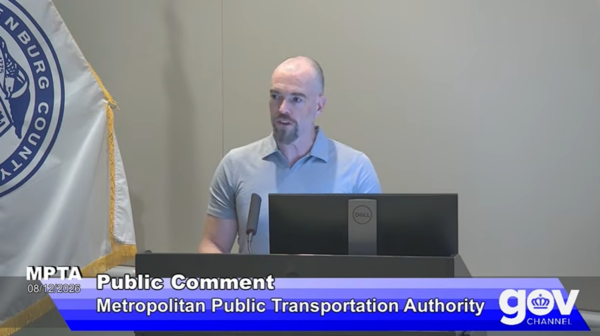
Good evening MPTA board members. My name is Eric Zaverl and I am speaking on behalf of Sustain Charlotte to urge you to include a Craighead station in the Red Line alignment.
This is the moment when the station will be least expensive to build. Adding it while the line is being designed and constructed means coordinating the platform, track, utilities, access, and surrounding infrastructure as one project. Leaving it out may reduce today’s budget, but it almost guarantees that taxpayers will pay far more later.
CATS is already learning this lesson the hard way. We are now spending approximately $34 million to add another South End Station to the Blue Line—while disrupting service on an operating rail line.
The Rail Trail bridge over I-277 offers another warning: after being removed from the original plan because of budget constraints. The new crossing was estimated at $11 million and has grown to approximately $16.4 million. Small savings today can become very expensive corrections tomorrow.
We should also remember that rail created what we now call South End. Once an industrial district with no housing, it is now one of Charlotte’s most walkable and economically vibrant mixed-use neighborhoods with thousands of residents.
That transformation did not happen because the area was already fully developed when the Blue Line arrived. Rail stations made housing, businesses, jobs, and public life possible. The residents of Charlotte’s North End deserve the same opportunity.
Finally, this is an issue of equity. Without Craighead, the Red Line would have a nearly six-mile gap—its largest—through predominantly Black neighborhoods. These communities have already borne the consequences of redlining, decades of underinvestment, and the construction of highways such as I-85.
Residents should not be asked to help fund a rail line only to watch its trains pass through their neighborhoods without stopping.
Please do not repeat the costly and inequitable mistakes of the past. Build Craighead now, while it is affordable, and ensure the Red Line creates opportunity for every community along its route.
What’s Next
Sustain Charlotte will continue to work alongside residents of North Charlotte to ensure they experience benefits from the Red Line. Together, we will ensure this study begins promptly and is both transparent and objective.