
Advancing Health Through Place: Our Role in the Collaboration for Equitable Health
Advancing Health Through Place: Sustain Charlotte’s Role in the Collaboration for Equitable Health
Health is shaped by far more than medical care alone. Where we live, how we move, and whether our neighborhoods offer safe, connected places to walk, bike, and gather all play a powerful role in long-term wellbeing. The Collaboration for Equitable Health (CFEH) was created with this understanding at its core: to address chronic health conditions by improving the systems, environments, and policies that influence daily life—especially in communities that have historically been under-resourced.
Convened by the American Heart Association, the American Diabetes Association, and the American Cancer Society, CFEH brings together organizations across sectors to advance equitable solutions that reduce barriers to health and expand opportunity. Sustain Charlotte has been proud to be a part of this collaboration since 2024, contributing our expertise in transportation, land use, and community engagement to address the built environment as a critical driver of chronic disease prevention.
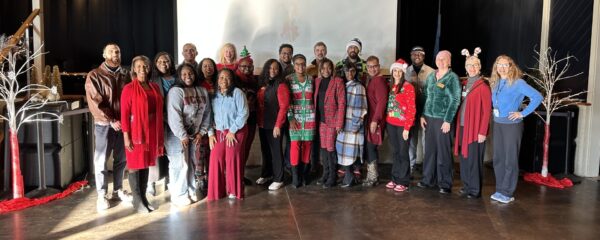
Coalition members gathered to celebrate this year’s progress and prepare for upcoming work in 2026!
Our work aligns closely with CFEH’s shared goals by focusing on improving access to safe, active transportation choices in underrepresented neighborhoods. Our efforts centered on ensuring that residents can more easily incorporate physical activity into daily routines, reach health care and healthy food, and stay socially connected—all key factors in preventing and managing chronic conditions such as heart disease, diabetes, and obesity.
One of our most significant contributions was transportation advocacy for walkable and bikeable communities. We mobilized residents to support increased transportation funding in Mecklenburg County, emphasizing investments in sidewalks, greenways, bike routes, and safer streets. These improvements expand opportunities for everyday movement while reducing physical barriers to essential services.

Greenways & parks improve health by allowing people to walk & bike safely.
In 2024, we played a pivotal role in securing $65 million in funding for sidewalks, Strategic Investment Areas, and transportation improvements serving Corridors of Opportunity—funding that had been cut shortly before the final city budget vote. Thanks to strong resident advocacy, these dollars were restored and included in the approved budget. We also helped secure $8 million to expand the bike network, $50 million for sidewalks, and $20 million to advance Vision Zero strategies aimed at reducing traffic fatalities and serious injuries.
We also worked to accelerate investment in greenways as transportation routes, recognizing their dual benefits for physical activity and mobility. Through petitions, meetings with county commissioners, and partnerships with community organizations, we helped secure $50 million for land acquisition for future parks and greenways, $3 million for improvements to existing facilities, and funding for 15 new Park and Recreation positions. Importantly, two critical segments of the Irwin Creek Greenway—previously omitted from the capital budget—were added, improving connectivity for West Charlotte neighborhoods.
Community engagement and education were central to our work within CFEH. We hosted five educational events in the 28208 zip code, engaging 345 residents in discussions about transportation, equity, and neighborhood health. An additional 182 residents participated in our Impact 704 Academy series, where topics ranged from greenways and bike networks to tree canopy, transit, and equitable development. More than 20 subject matter experts and resident leaders presented, and 86% of survey respondents reported they were likely to take an advocacy action within three months.
While Sustain Charlotte’s role as a grantee in the Collaboration for Equitable Health concluded in 2024, our commitment has not. We remain actively engaged in CFEH’s shared mission and continue to advance policies and community-driven solutions that recognize transportation and the built environment as essential components of health equity.