
Charlotte Sees Vision Zero Progress, but Pedestrian and Bicycle Fatalities & Serious Injuries Rise
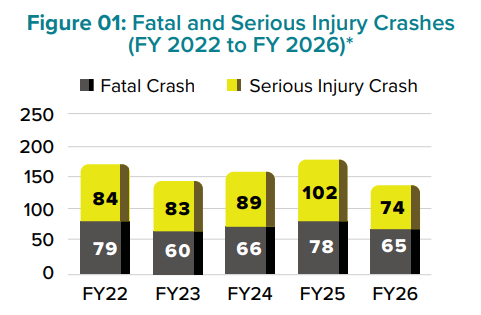
Charlotte’s latest Vision Zero Annual Report brings some genuinely encouraging news: overall fatal and serious injury crashes declined significantly compared to last year.
Fatal crashes fell 16.7% from the previous year, while serious injury crashes fell 27.5%, reaching their lowest level in five years.
But the report also contains a troubling warning: people walking and biking continue to face a disproportionate and growing share of the danger on our streets. People walking and biking were involved in just 1.2% of all crashes, yet they accounted for 37% of fatal and serious injuries, the highest share in five years and up from 28% last year.
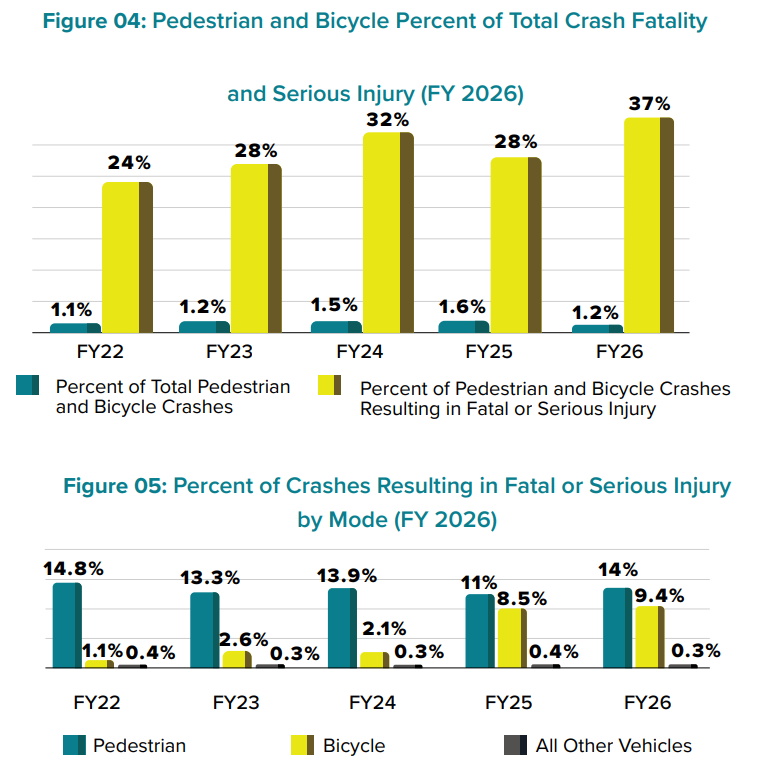
It’s also much more dangerous to be involved in a crash if you’re hit by a car while walking or biking than if you’re inside a car. About 14% of pedestrian crashes and 9.4% of bicycle crashes resulted in a fatality or serious injury, compared with just 0.3% of crashes involving only motor vehicles.
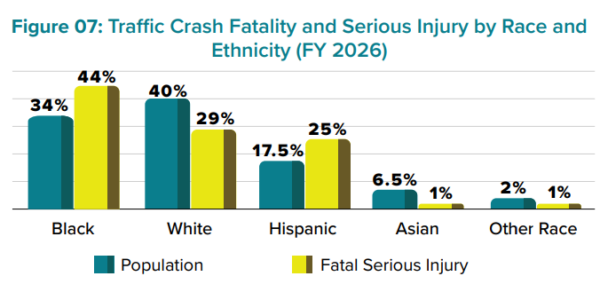
The inequities are geographic and racial, too. Black residents make up about 34% of Charlotte’s population but accounted for 44% of fatal and serious injuries. And areas with higher Transportation Disadvantage Index scores ( a tool that evaluates factors including race, income, personal vehicle access,, mobility impairments, age, and Limited English Proficiency) contained 54% of Charlotte’s population but experienced more than 70% of fatal and serious injury crashes.
There is a lot in this year’s report that deserves recognition.
During FY 2026, CDOT installed 22 new traffic signals, including nine pedestrian hybrid beacons, added four rapid-flashing pedestrian beacons, lowered speed limits on 83 streets, upgraded more than 1,300 streetlights, and added or improved nearly 17 miles of sidewalk and more than 10 miles of bicycle facilities.
City Council approved a pilot red-light camera program of up to 10 intersections, something Sustain Charlotte has strongly supported. Many of you contacted Council ahead of their June 22 vote and advocated for this program, which is now soliciting proposals via an RFP process and expected to launch in 2027.
Charlotte’s Vision Zero principles state clearly that protecting human lives takes priority over all other objectives. Vision Zero asks us to make a simple commitment: No one should die or suffer a life-changing injury simply because they are trying to get around Charlotte.
Living up to that principle will sometimes require difficult decisions. For decades, many streets in Charlotte were designed primarily to move cars quickly. Creating a safer transportation system means being willing to redesign those streets, lower speeds, shorten crossings, add protected space for people biking, and sometimes reallocate vehicle lanes.
The latest data show why that matters. Speeding and improper vehicle operation together were contributing factors in 62% of fatal and serious injury crashes. We have to design streets so that inevitable human mistakes are less likely to kill or seriously injure someone.
We must continue until no one dies on our streets
Sustain Charlotte and our neighborhood partners began advocating in 2017 for Charlotte to make Vision Zero a citywide goal. We helped build public support for its adoption and have served on the Vision Zero Task Force since its beginning.
Today, our Director of Engagement & Impact, Meg Fencil, serves as co-chair of the Task Force alongside CDOT Deputy Director Charles Jones. The Task Force was refreshed this year with a renewed focus on accountability, implementation, and collaboration.
Last year, we called for Charlotte to move with greater urgency after both fatal and serious injury crashes increased. We’re encouraged by the progress documented in this year’s report, yet alarmed that even more people walking and biking lost their lives and suffered life-altering injuries compared to last year. There can be significant variability from one year to the next, so it’s important to work towards a long-term downward trend, with the only acceptable goal being zero traffic fatalities and serious injuries.
We need to accelerate safety improvements on the most dangerous streets, move quickly on automated enforcement and speed management, invest more aggressively in safe walking and biking infrastructure, and be willing to make difficult choices when safety and vehicle speed compete.