
Charlotte Needs Time to Get Data Center Policy Right
Council members discussed a proposed 150-day moratorium on new data center development at their June 1 Transportation, Planning and Development committee meeting (watch here, starting at 7:15). Planning Director Monica Holmes presented what the moratorium would mean for projects already in the development pipeline.
Data centers can have major impacts on land use, energy demand, water use, noise, public health, and nearby neighborhoods. Before Charlotte allows more of these facilities to move forward, city staff, council members, and residents need time to fully understand what is being proposed, where these facilities could be located, and how they align with Charlotte’s adopted environmental, equity, and land-use goals.
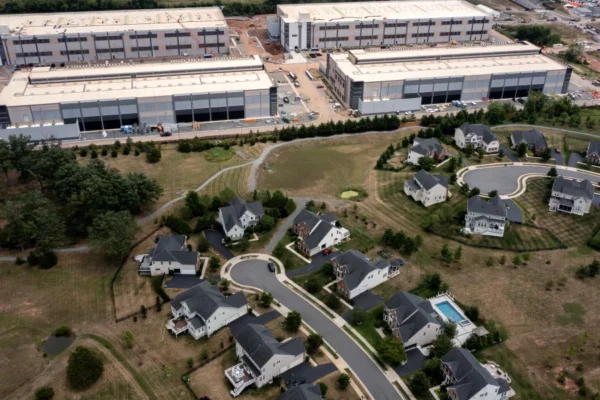
Across the country, data centers are often built close to homes. (image: Nathan Howard/Getty Images)
Pausing the project pipeline
During the committee discussion, staff explained that four data center projects (see table below) are already in the development pipeline.

Because those projects submitted complete applications before the moratorium would take effect, they are expected to be exempt from the pause and allowed to continue through the current review process. That makes the moratorium even more urgent. Charlotte is already facing significant data center interest, and without a temporary pause, more projects could advance before the city has clear policies in place.
Council members raised important questions about the difference between smaller “edge” data centers and large hyperscale facilities, some of which could require hundreds of megawatts of power. They also asked about how data centers could affect Charlotte’s Strategic Energy Action Plan goals, water resources, and surrounding communities.
Focusing on primary use
A well-designed moratorium can give Charlotte the opportunity to study and regulate these impacts without unintentionally hindering innovation, economic activity, or the normal technology needs of existing businesses. The moratorium should address facilities where data storage and processing are the primary land use, particularly large-scale commercial and hyperscale data centers.
The intent should not be to prevent hospitals, universities, manufacturers, office campuses, research institutions, or other businesses from operating the servers and technology infrastructure needed to support their day-to-day work. Instead, the focus should be on stand-alone data center developments whose significant demands on land, energy, water, and infrastructure create unique planning and environmental considerations.
The environmental justice concerns are significant. Data centers can bring constant noise, heavy energy demand, backup diesel generators, heat, and infrastructure burdens. If these facilities are concentrated in communities that have already experienced industrial land uses, disinvestment, pollution, or limited public infrastructure, they could deepen existing inequities. Residents deserve a voice before long-term decisions are made about where and how data centers are allowed.
Our Take:
A 150-day moratorium is a responsible planning tool. It gives Charlotte time to study best practices, engage residents, evaluate environmental and health impacts, and develop policies that protect communities while guiding future development.
Charlotte has made commitments to sustainability, equity, and thoughtful growth. Those commitments should guide data center policy from the start, not after projects are already approved.
We encourage you to check out Action NC’s excellent online Data Center Information Hub to learn more and get involved.
Sustain Charlotte strongly supports the proposed 150-day moratorium and urges City Council to vote yes on Monday, June 8.