
MPTA Transition Update: Council Raises Key Questions About Equity, Sustainability, and Service
At the June 1 Charlotte City Council Transportation, Planning and Development Committee meeting (view here, from timestamp 6:07 to 7:14), members received an update on the transition of Charlotte Area Transit System (CATS) operations to the newly created Metropolitan Public Transportation Authority (MPTA). While much of the presentation focused on organizational readiness and governance, council members raised important questions that align closely with Sustain Charlotte’s priorities around equitable growth, transit access, and sustainability.
The MPTA’s Board Chair and the City’s legal counsel outlined progress in establishing governance structures, adopting bylaws, hiring legal and financial advisors, and preparing for a phased transition of transit operations. The goal is for the authority to assume full responsibility while ensuring transit riders and employees experience minimal disruption.
Several council members emphasized the importance of keeping equity and community outcomes at the center of the transition.
Displacement
Council Members Renee Johnson and Malcolm Graham asked how conversations about displacement are being incorporated into the MPTA’s planning process. As transit investments shape development patterns across Charlotte, she stressed the need to ensure that housing affordability and displacement concerns remain part of the conversation.
MPTA Chair David Howard responded that affordable housing and displacement are among his top priorities and that he will continue those discussions as the authority evolves. However, the MPTA has limited tools to address displacement directly, since the P.A.V.E. Act that authorized the new one-cent mobility sales tax limits the expenditure of those revenues to transportation infrastructure. Howard emphasized that the MPTA will need to work closely with Mecklenburg County, City of Charlotte, and the six municipalities to coordinate anti-displacement efforts.
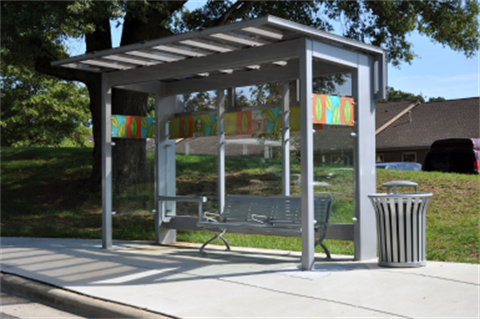
Bus shelters
Council Member LaWana Mayfield raised concerns about bus stop access and shelter placement, noting that transit riders across the city deserve safe and comfortable waiting environments. CM Graham expressed concerns that adding only 100 shelters in the first year is not enough. Howard acknowledged the issue and highlighted ongoing efforts to expand shelters, while also recognizing the need for equitable distribution throughout the transit network. He brought up the valid point that not all bus stops can look identical due to differences in the land they sit on. For example, many bus stops are in a resident’s front yard, and it’s not possible to put a full shelter there.
(image: CATS)
Climate and environment
Environmental sustainability was another area of focus. Council member Kimberly Owens asked how the MPTA will support Charlotte’s adopted Strategic Energy Action Plan (SEAP) and broader climate goals. While the authority’s immediate focus is on establishing a stable organization and maintaining service continuity, Howard emphasized that innovation and sustainability remain important priorities. He noted that the authority intends to address long-term opportunities once the transition is complete and core operations are fully established.
Planning a smooth transition
The discussion also highlighted the close partnership between the City of Charlotte and the MPTA during the transition period over the next 6 months. City staff explained that Charlotte will continue to provide administrative support, payroll services, procurement assistance, legal guidance, and operational expertise while the authority builds its internal capacity. This phased approach is intended to ensure continuity for CATS employees and transit riders while protecting public investments.
Our take:
For Sustain Charlotte, these conversations underscore the importance of building a transit system that not only moves people efficiently but also advances affordability, environmental sustainability, and equitable access to opportunity. As the MPTA transition continues, we look forward to seeing these priorities remain central to the region’s transit future.
It’s imperative that the MPTA fully commit itself to the adopted Strategic Energy Action Plan (SEAP) goals to transition to a fully electric bus fleet and pursue an electric train (not diesel) for the Red Line commuter rail. This will ensure not only that residents in these transit corridors breathe clean air, but also that CATS operations support a healthy climate by reducing greenhouse gas emissions.
In November 2025 Mecklenburg County voters said “YES!” to improving our transit system and building complete streets for all. Now that we’re poised to make a huge public investment in mobility, residents should be able to live within a reasonable distance of transit without fear that this investment will also cause displacement. We urge our local governments to work closely with the MPTA to adopt and implement an anti-displacement policy, and to align housing and small business investments accordingly.