
Charlotte’s Blue Line Created Billions in Value. Let’s Capture More of It Next Time.
By Shannon Binns | Sustain Charlotte Founder
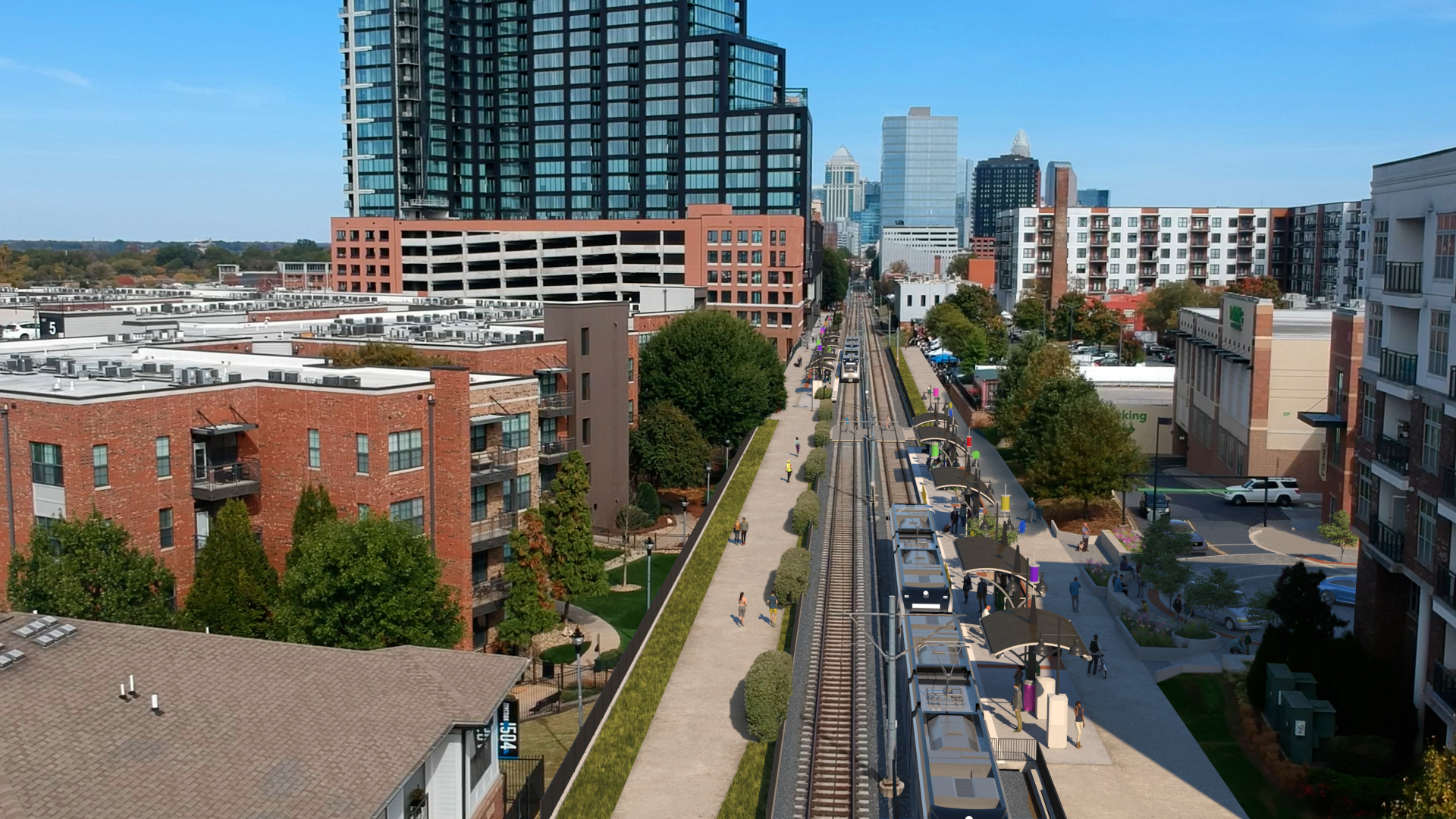
(Photo: This undated photo from the City of Charlotte shows development along the Blue Line south of Uptown.)
Charlotte already knows that rail can do much more than move people. It can reshape where our city grows — and create enormous economic value in the process.
The numbers are remarkable.
As of March 2025, the Charlotte Area Transit System identified more than $10.1 billion in estimated project value along the original Blue Line and Blue Line Extension corridors, encompassing nearly 40,000 housing units and 8.7 million square feet of nonresidential development.[1]
South End provides perhaps the most visible example. What was once largely an industrial district has become one of Charlotte’s most intensely developed neighborhoods. The City of Charlotte now places the assessed property value of the South End municipal service district alone at approximately $6.3 billion.[2]
And the phenomenon didn’t stop south of Uptown. Along the Blue Line Extension toward UNC Charlotte, CATS identifies another $3.28 billion in completed or under-construction projects and nearly 16,900 housing units as of March 2025.[1]
This is an extraordinary success story.
It also raises an important question as Charlotte prepares to make its next generation of rail investments:
When billions of dollars in public investment help create billions more in private land value, shouldn’t some of that new value help pay for the public investment that helped create it — and for other public benefits our growing community needs?
Other cities already do this
The idea has a name: value capture.
The basic concept is straightforward. Public investment in rail and other transportation infrastructure often makes nearby land more accessible and substantially more valuable. Rather than allowing all of that newly created value to accrue privately, communities can use various mechanisms to return a portion of it to public purposes.
This isn’t a novel idea. The Federal Transit Administration and Federal Highway Administration identify tax increment financing, special assessments and joint development among the tools communities can use to capture some of the value associated with transportation investments.[3]
And several major U.S. projects demonstrate how significant these mechanisms can be.
Atlanta offers a particularly relevant comparison for Charlotte. The Atlanta BeltLine established a Tax Allocation District — Georgia’s form of tax increment financing — that uses growth in property-tax revenue within the district to support parks, trails, transit, affordable housing and other public investments. The district was originally projected to generate $3 billion toward a $4.4 billion program, or roughly two-thirds of its anticipated cost. Those projections were later reduced substantially after the Great Recession, but the BeltLine continues to use the district as a major funding source and has since added another special taxing district.[4]
Northern Virginia used a different approach to help finance the Washington Metro Silver Line through Tysons and to Dulles International Airport. Commercial landowners understood that rail access would increase the value and development potential of their properties, and major landowners helped organize support for special tax districts to help fund the line. Value-capture sources ultimately financed approximately one-fifth of the $5.7 billion project. Fairfax County’s special tax districts were expected to provide about $730 million across the two phases, with Loudoun County employing a similar mechanism.[5]
San Francisco demonstrates another approach at an even larger scale. The Federal Highway Administration describes the $4.2 billion Transbay Transit Center project as combining a major transit hub and rail extension with redevelopment of surrounding land. Sales of publicly owned land generated approximately $516 million, while new property-tax revenues generated by surrounding redevelopment were pledged to repay a $171 million federal transportation loan. The redevelopment also created opportunities for thousands of homes, parks and commercial development.[6]
The mechanisms differ, but the principle is the same: when public investment creates substantial private economic value, communities can capture a portion of that value to help pay for the infrastructure and public benefits that made it possible.
North Carolina already gives us some tools
Charlotte does not have unlimited authority to create its own taxes or financing mechanisms. North Carolina municipalities operate within powers granted by the state, so any serious value-capture strategy has to begin with what state law allows.
Fortunately, we are not starting from zero.
North Carolina already authorizes project development financing, the state’s version of what is commonly called tax increment financing, or TIF.
Under this approach, a local government can establish a development financing district with a baseline property valuation. As development occurs and assessed values increase, the additional property-tax revenue generated by that growth can be used to repay debt issued for qualifying public improvements.
North Carolina law expressly allows project development financing for public transportation facilities, including railways.[7]
That distinction is important. TIF does not necessarily mean increasing the general property-tax rate. Instead, it can dedicate some of the new tax revenue generated by growth in property values and development to public investments that support or helped make that growth possible.
There are safeguards and limitations. Development financing districts must follow state statutory requirements. Mecklenburg County has the opportunity to review and disapprove a proposed district, and project development financing requires approval from the North Carolina Local Government Commission.[8]
So Charlotte can explore this tool under existing state law, but it requires coordination among city, county and state partners.
Another option worth evaluating is a transit-oriented municipal service district. North Carolina law specifically authorizes cities to establish municipal service districts for transit-oriented development and levy an additional property tax within them for enhanced services and facilities that benefit the district.[9]
The precise applicability and timing of this authority for financing future rail lines deserves careful legal analysis. But Northern Virginia’s experience illustrates the broader idea: property owners who receive particularly large financial benefits from a transportation investment can help pay for that investment.
Charlotte and our regional transit authority should also aggressively explore strategic public land acquisition and joint development.
Acquiring key parcels near future stations before rail investment significantly increases their value can allow the public to participate directly in future appreciation. Publicly owned land can later generate revenue through ground leases, development agreements or sales while also creating opportunities for affordable housing, parks, public spaces and other community needs.
Once land prices have dramatically increased, that opportunity becomes much more expensive — or disappears altogether.
The General Assembly has already pointed us in this direction
Perhaps the strongest reason to begin this work now is that the North Carolina General Assembly has already told our region to evaluate many of these ideas.
The 2025 legislation establishing Mecklenburg County’s new transit funding structure and Metropolitan Public Transportation Authority requires a value-engineering study of the Silver Line East.
That study must examine potential additional revenue sources including municipal service districts, tax increment financing, public-private partnerships, station rents and station air rights, among other possibilities.[10]
So exploring value capture would not be an attempt to work around Raleigh.
State lawmakers themselves have put these tools on the table.
Charlotte, Mecklenburg County, our regional transit authority and state leaders should now work together to determine which combination makes the most sense for each corridor — and whether additional authority from the General Assembly could give our region even better tools.
Capture value — and return it to the community
There is an important purpose here beyond simply paying for rail.
Transit investment can bring tremendous opportunity, but rapidly increasing land values can also raise rents, increase redevelopment pressure and contribute to displacement of existing residents and locally owned businesses.
That means value capture should not simply be a financing strategy. It should also be a community-benefit strategy.
Some of the value generated by public investment could support affordable housing near transit, safer walking and biking connections to stations, parks and public spaces, infrastructure improvements and other investments that allow more people to benefit from transit-oriented growth.
Policies should also be designed carefully to avoid placing unreasonable burdens on lower-income homeowners, renters and small businesses.
The underlying principle is simple:
We need to act before the value is created
When public investment creates value, some of that value should come back to the public.
The most important word in this entire discussion may be before.
We did not know exactly what would happen when Charlotte planned its first light-rail line. At the time, nobody could be certain whether rail in a sprawling, automobile-oriented Southern city would catalyze billions of dollars in development.
Now we know.
The original Blue Line helped catalyze billions of dollars in investment south of Uptown. Then the Blue Line Extension was followed by billions more north of Uptown.
That knowledge gives us an enormous advantage as we plan the Red and Silver Lines and consider future investments in the Gold Line.
But value-capture strategies work best when they are established before public investment dramatically increases surrounding land values — not afterward, when much of that value has already been created and captured.
Charlotte, Mecklenburg County, our regional transit authority and state leaders should begin developing that strategy now.
That should include serious evaluation of project development financing, transit-oriented municipal service districts, strategic public land acquisition and joint development, station rents and air rights — along with identifying any additional authority our region may need from the state.
Not every mechanism will be appropriate for every corridor. We should study the economics carefully, protect existing communities and choose the tools that produce the greatest public benefit.
But doing nothing should no longer be the default.
Charlotte taxpayers are preparing to invest billions of dollars in a transportation system that can make our community more connected, prosperous and sustainable.
We already know those investments can also help create billions of dollars in private real-estate value.
This time, let’s make sure some of that value comes back to the community that helped create it.
Footnotes
[1] Charlotte Area Transit System, FTA Quarterly Review Meeting, March 25, 2025. The report lists $6.878 billion in estimated project cost and 22,858 residential units along the original Blue Line corridor and $3.281 billion and 16,895 units along the Blue Line Extension.
https://www.charlottenc.gov/files/sharedassets/cats/v/1/cats-docs/fta-quarterly-reports/cats-fta-quarterly_report_2025-3-25_final_report.pdf
[2] City of Charlotte, FY2026 Adopted Budget.
https://www.charlottenc.gov/files/sharedassets/city/v/3/city-government/departments/documents/budget/fy2026/adopted-fy2026-budget.pdf
[3] Federal Transit Administration, “Value Capture.”
https://www.transit.dot.gov/valuecapture
Federal Highway Administration, Value Capture Program.
https://www.fhwa.dot.gov/ipd/value_capture/
[4] Federal Highway Administration, “Atlanta BeltLine Tax Allocation District.” FHWA notes that the district was originally projected to generate $3 billion toward $4.4 billion in anticipated investment and documents the subsequent reduction in projected revenues following the Great Recession.
https://www.fhwa.dot.gov/ipd/value_capture/case_studies/atlanta_beltline_tax_allocation_district.aspx
[5] Federal Highway Administration, “Silver Line/Dulles Metrorail Special Assessment District.”
https://www.fhwa.dot.gov/ipd/value_capture/case_studies/silver_line_dulles_metrorail_special_assessment_district.aspx
[6] Federal Highway Administration, “Transbay Transit Center” project profile.
https://www.fhwa.dot.gov/ipd/project_profiles/ca_transbay_transit.aspx
[7] North Carolina General Statutes §§ 159-103 and 159-48(b)(23), which authorize project development financing for qualifying purposes including public transportation facilities, buses and railways.
https://www.ncleg.gov/EnactedLegislation/Statutes/HTML/ByChapter/Chapter_159.html
[8] North Carolina General Statutes § 158-7.3. The statute provides for county review and requires Local Government Commission approval before a development financing plan and district become effective.
https://www.ncleg.gov/EnactedLegislation/Statutes/HTML/BySection/Chapter_158/GS_158-7.3.html
[9] North Carolina General Statutes § 160A-536.
https://www.ncleg.gov/EnactedLegislation/Statutes/HTML/BySection/Chapter_160A/GS_160A-536.html
[10] North Carolina Session Law 2025-39, § 6.4(11).
https://www.ncleg.gov/EnactedLegislation/SessionLaws/HTML/2025-2026/SL2025-39.html