
I-77 South Update: Fewer Impacts, Same Fundamental Problems
At the April 6 Transportation, Planning & Development Committee meeting (watch the video here), NCDOT presented an update on the proposed I-77 South toll lane project. The agency emphasized design changes, expanded community engagement, and efforts to reduce harm.
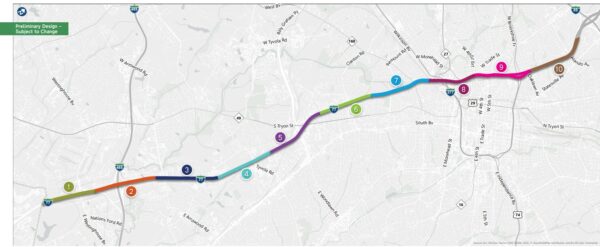
New toll lanes would be added from the Brookshire Freeway all the way to the state line. (map: NCDOT)
But after nearly 90 minutes of discussion, one thing became clear:
reducing impacts is not the same as solving the underlying problem.
This project still reflects a highway-first approach that risks displacement, raises equity concerns, and diverts attention from the transportation investments Charlotte actually needs.
What NCDOT Highlighted
NCDOT’s presentation focused on showing progress.
They’ve opened a new community engagement center along the corridor, held dozens of outreach sessions, and updated preliminary design plans. Those plans include changes such as retaining walls, ramp realignments, and elevated sections intended to reduce impacts on nearby properties, parks, and historic areas.
Staff showed examples of how impacts on places like parks, cemeteries, and community assets have been reduced or avoided.
But reducing specific harms is not the same as providing a project that is a net win for Charlotte.
Displacement Is Still on the Table
One of the most important moments in the meeting came when Councilmember Ajmera asked a direct question:
Can NCDOT guarantee that no homes will be taken?
The answer was no.
Even with revised designs, NCDOT acknowledged that home displacement is still likely, particularly in constrained areas along the corridor, such as the West Blvd interchange in the Wilmore neighborhood.
For communities that have already experienced decades of harm from highway construction, that uncertainty remains a central concern.
An Outdated Framework Driving Today’s Decisions
Another key tension in the discussion was how this project came to be.
NCDOT repeatedly pointed back to long-standing planning decisions, including a regional “managed lanes” study from the mid-2000s, and to the fact that state funding is tied specifically to this type of project.
In other words, the justification for moving forward is largely procedural: this is what the plan has been, and this is what the money is allocated for.
But Charlotte in 2026 is not Charlotte in 2007!
Councilmember Watlington raised an important question when she asked about the goal of the study that led to a recommendation for toll lanes on I-77 South. :
NCDOT responded that the study’s purpose was to identify highway corridors where reliable travel times could be achieved on managed (ie, toll lanes). However, this is not the same as providing congestion relief — or real mobility options — for the majority of residents who can’t afford to use the toll lanes every day.
Paying for the Project Drives the Project
The financial structure behind I-77 South also came into sharper focus as Councilmember Johnson asked how NCDOT is determining which bidder to select since the project cost may change depending on the final design.
NCDOT confirmed that a traditional public toll project is not considered financially feasible. Instead, the state is pursuing a public-private partnership (P3), where private developers would help finance, build, and operate the lanes.
That model introduces a basic reality:
Toll revenue will be used first to pay off project debt and cover costs.
This raises a fundamental concern. When a project’s success depends on toll revenue, the system is designed to maintain that revenue stream—not necessarily to maximize public benefit.
It also limits how much of that revenue can be reinvested into surrounding communities, even as those communities bear the impacts.
Managed Lanes Don’t Solve the Bigger Problem
NCDOT continues to frame the project as a “managed lanes” solution. The operator will use variable toll pricing to maintain reliable travel times.
Those lanes may function as intended for those who can afford to use them. But the meeting highlighted an ongoing equity concern raised by Councilmember Ajmera:
There is no guarantee that congestion will meaningfully improve in the general-purpose lanes.
That means that the great majority of drivers could see little benefit, while a subset gains access to faster, tolled travel.
NCDOT is instead focused on optimizing utilization of the toll lanes. At the same time, the project continues to prioritize highway expansion over investments that could reduce reliance on driving altogether—such as transit, safer streets, and better-connected neighborhoods.
Community Benefits Are Still Unclear
NCDOT and state partners have identified roughly $100 million in potential “community benefits,” including pedestrian connections, bridges, and noise mitigation.
But during the meeting, those benefits remained largely conceptual.
Communities are being asked to weigh clear and immediate risks—including displacement and long-term environmental impacts—against benefits that are still undefined.
That imbalance makes it difficult to build trust.
Councilmember Mazuera Arias raised concern that 3 of the 4 companies that have submitted bids are foreign-based, so the revenues generated would not return to the community beyond any required community benefits already negotiated at the beginning of the project.
The Bigger Question: What Kind of City Are We Building?
Perhaps the most important takeaway from this meeting is not about design details or financing structures.
It’s about direction.
Charlotte is growing rapidly. The choices we make now will shape how people move, where they live, and whether our transportation system works for everyone.
The I-77 South proposal continues to invest heavily in a model that:
- prioritizes car travel over multimodal options
- risks further dividing historically impacted communities
- relies on tolling structures that raise equity concerns
Sustain Charlotte believes we can—and should—do better.
A Better Path Forward
This moment calls for a broader conversation about alternatives.
What would it look like to invest those resources into:
- transit that moves more people efficiently
- safer streets for walking and biking
- reconnecting communities divided by past infrastructure decisions
- and a transportation system that reduces—not reinforces—dependence on driving
The April 6 meeting showed that public scrutiny is working. Council members are asking harder questions. Residents are demanding clearer answers.
But it also showed that the core issues with the I-77 South project remain unresolved.
Charlotte should not settle for a project that is simply less harmful than before.
We should be pursuing one that actually moves our city forward.