
Council Committee Resumes I-77S Toll Lanes Discussion
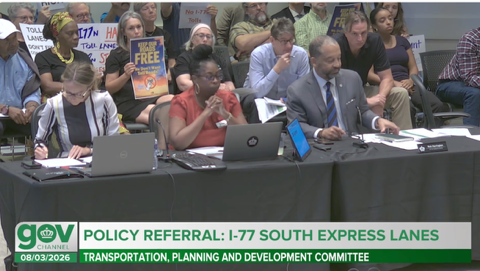
Charlotte residents have spoken clearly about the proposed I-77 South toll lanes. After months of public concern over the project’s cost, design, neighborhood impacts, and public-private partnership structure. On May 11 2026, Council voted 6-5 to rescind the City’s support for the I-77 South toll lane project. The Charlotte Regional Transportation Planning Organization (CRTPO) followed by withdrawing its support on May 20.
Now, just a few months later, state action is putting enormous pressure on local leaders to reverse those decisions.
At the August 3 meeting of Charlotte City Council’s Transportation, Planning, and Development Committee (video here; begins at 09:05:15 timestamp), Council members discussed a new state budget provision that could require Charlotte and other jurisdictions to repay tens of millions of dollars already spent by NCDOT on the project if the region does not reverse course.
Councilmember Malcolm Graham focused heavily on how little time Council now had to rebuild public consensus around a project that had generated months of controversy. He questioned whether Charlotte could conduct a credible community process within the approximately six weeks available before Council would realistically need to act.
As Graham put it: “I’m not sure we can do a whole lot in six weeks that will be respected and accepted by the community.” He specifically expressed hope that Gov. Josh Stein was paying attention to the dilemma facing Charlotte.
Councilmember Renee Johnson, who made the successful May motion to rescind Charlotte’s support, argued for a special City Council meeting devoted to I-77 South. Johnson wants a meeting where residents could fill the Council chamber and publicly demonstrate the scale of opposition. She specifically challenged the suggestion that opposition to the toll-lane project amounted to only a relatively small number of activists or residents.
Charlotte’s decision deserves to be respected
Council’s vote in May 2026 to rescind their support for a P3 project to build toll lanes on I-77S came after months of public engagement and growing concern from residents about a project that could fundamentally reshape the I-77 corridor for generations.
That vote demonstrated that public participation can influence major transportation decisions. Reversing that decision now, and without fundamental changes to the project or clear public support for doing so, would send the opposite message. It would tell residents that even when they organize, participate, and persuade their elected representatives, their voices may still be outweighed by pressure from Raleigh.
The new state repayment provision creates an extraordinary dilemma for Charlotte. Local leaders are now being asked to reconsider the project while facing the possibility that maintaining their previous position could cost the City and other local governments tens of millions of dollars.
Charlotte still needs better transportation choices
Charlotte is growing rapidly, and our transportation system must evolve with it. But adding highway capacity through tolled express lanes is not the only tool available! That’s why Sustain Charlotte recently published our report A Better Way Forward: Strategies to Improve Mobility, Reliability, and Safety on I-77 South,
We should be investing aggressively in a transportation system that gives people meaningful alternatives to driving alone: frequent and reliable transit, safer walking and biking networks, better connections between neighborhoods and transit, and land-use patterns that allow more people to live near jobs, services, and daily needs.
Our Take: Council should stand by its decision
Sustain Charlotte has worked in close partnership with neighborhood organizations and the Black Political Caucus for months, informing residents and organizing them to take action on behalf of their communities. Charlotte residents participated in the process and raised legitimate concerns. Their elected representatives considered those concerns and made a decision, which hould not be discarded simply because the political and financial pressure to reverse it has intensified.
Council should stand by its May vote to rescind support for the I-77 South toll lane project. Residents deserve to know that when they show up, participate, and make their voices heard, their local government will listen.
Sustain Charlotte urges City Council to respect that public voice and stand firm. We join Councilmember Johnson in urging Council to host a full special public meeting on this topic.